
UX Report – Findings and Improvement Suggestions
Initial review of the Carnes A Punto and Carnes a Domicilio websites to identify opportunities to improve navigation, content and architecture. It gathers key observations, competitor best practices and visual recommendations.
 Marie Garrido
- Role
- UX/UI Designer
- Agency
- Laika, the digital agency of Dittborn & Unzueta
- Client
- Carnes A Punto (carnesapunto.cl and carnesadomicilio.cl)
- Scope
- Initial review: market and consumer, web performance of the 2 own sites and 7 competitors, and preliminary recommendations
- Outcome
- 6 recommendations and a Home hypothesis (a direction, not a final design)
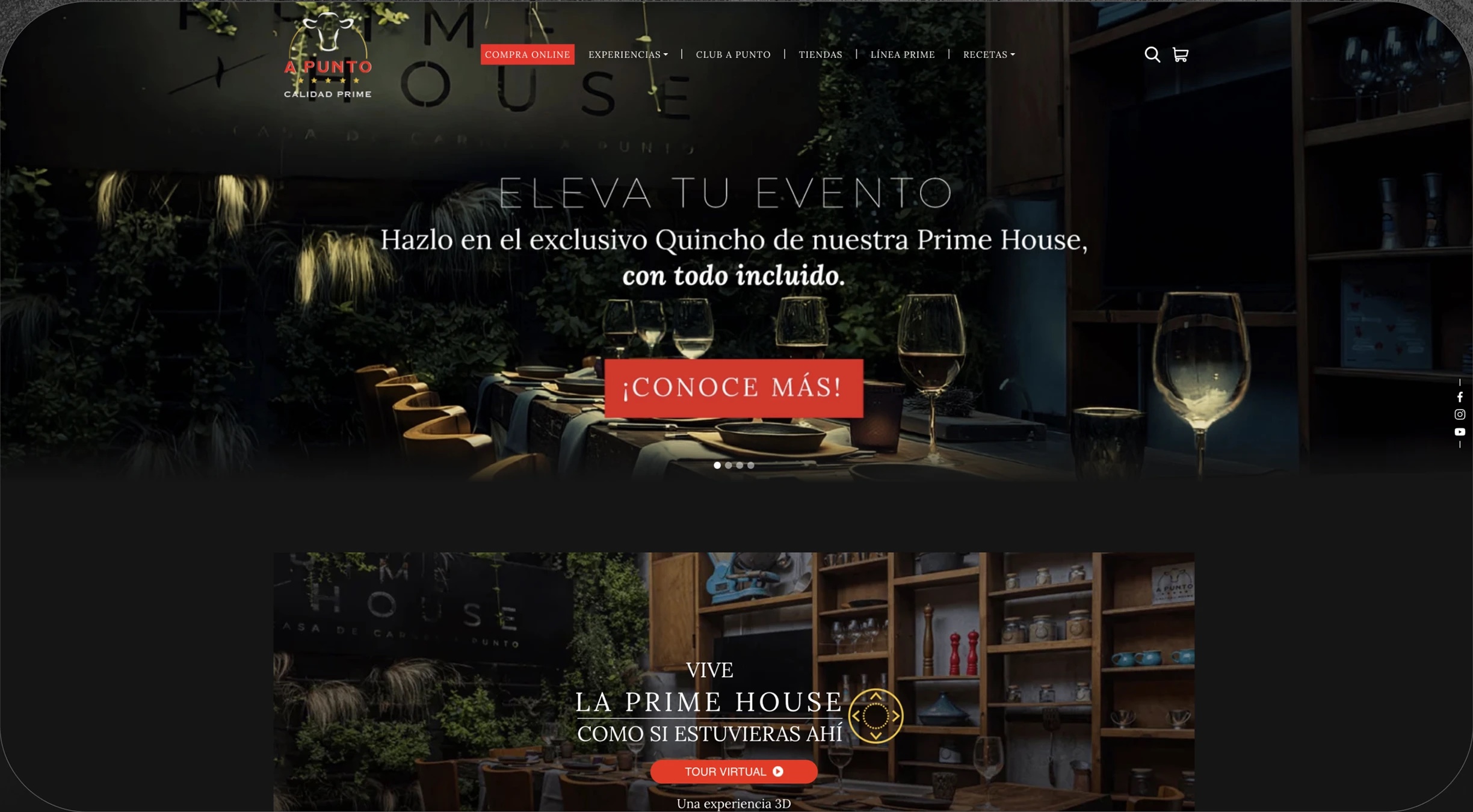
Project objectives
Optimizing the digital experience of Carnes a Punto
- Increase online sales by optimizing the purchase flow on Carnesapunto.cl and Carnesadomicilio.cl.
- Increase use of the Quincho (the Prime House event space) by strengthening content, visibility and value proposition within the ecosystem.
- Improve product findability by optimizing navigation, filters and information architecture.
Chilean market: high consumption + strong digital growth
Chile remains among the world's largest meat consumers (OECD, 2022).
In parallel, online commerce keeps growing steadily, driven by accelerated digital transformation, greater security in payment channels and more usable platforms.
This context directly favors selling meat products online, especially in quick-purchase and home-delivery models.
Unlike other products, selling fresh meat online is a bigger challenge: it requires knowing the customer deeply, their buying habits and their expectations of safety and food hygiene.
To design a trustworthy and effective experience, it is essential to study the real user, understand their frictions and needs, and at the same time respond to the goals of the stakeholders involved.
Market challenges for selling meat online
The meat sector faces specific challenges when moving to the digital channel. These are the key factors that shape the purchase experience and user trust.
1. Price as a perceived barrier
Although price doesn't vary significantly between physical and online stores, many consumers still find it hard to justify the purchase without seeing the product's quality.
2. Logistics and food safety
The transport and distribution chain is the main challenge: fresh products depend on reliable, consistent shipping systems. Despite progress, there are limitations that affect the experience.
3. New generations driving the channel
Millennials and Gen Z are more used to buying online and will be the ones to accelerate adoption of the channel for fresh products, including meat.
4. Need to know the customer
E-commerce makes it possible to understand consumer habits and needs more precisely. This information is key to adapting the platform, improving the experience and meeting business goals.
- Source cited: "Chile is one of the countries that consumes the most meat in the world" (Grupo Prensa Digital, August 25, 2022).
- Source cited: "Six reasons why e-commerce keeps growing in Chile" (Grupo Prensa Digital, August 12, 2022).
The Chilean consumer
According to Deloitte's study "Food Preferences and Trends in Chile, 2021", patterns can be identified that contextualize meat consumption within the Chilean market. These findings help us better understand buying habits, consumer priorities and frequency of consumption of fresh products.
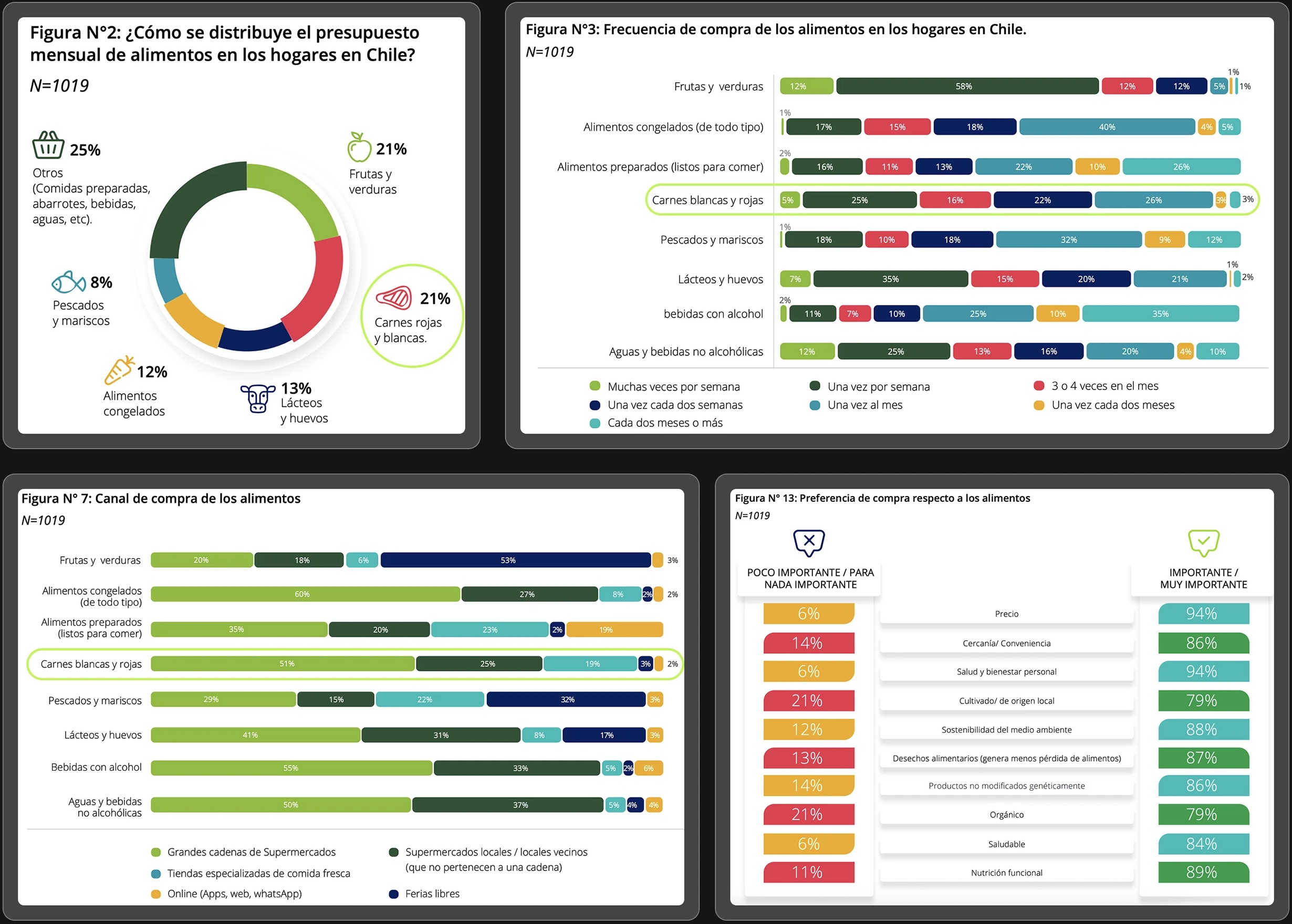
Key insights from the Deloitte study (2021)
The weight of meat
- Meat represents 21% of the monthly food budget in Chilean households, establishing itself as one of the highest-spending, highest-priority categories.
Purchase frequency is high
- At least 68% of the population buys meat once every two weeks or more, which shows stable, recurring consumption.
The dominant channel is still physical
- 51% buy meat at large supermarket chains.
- 25% at local supermarkets.
- Only 2% buy through apps or websites, which reveals a big opportunity for the digital channel, currently underdeveloped.
Decision factors are increasingly complex
- For a satisfying purchase, consumers need clear, reliable information: whether the product is organic, nutritional information, origin and provenance, cut type, certifications and cold-chain handling, among others.
- This obliges sites to offer a complete, transparent product sheet.
A clear digital opportunity
- Low online participation is explained more by distrust and lack of information than by lack of interest. A solid digital experience can capture a market that today buys almost exclusively in person.
The UX/UI challenge: build an experience able to…
- Build trust in fresh products (transparency, traceability, quality).
- Offer a simple, safe purchase flow.
- Inform clearly to support more conscious decisions.
- Translate traditional buying habits into the digital environment.
Growing interest in meat-related knowledge
In recent years, consumer interest in learning more about meat has grown significantly: from identifying the best cuts to knowing their ideal preparation depending on the type of grill or cooking method. Media, brands and experts are producing more and more educational content that the public actively seeks out.
Observed trends
- Posts highlighting the best grilling cuts and how to choose them.
- Content about recommended cuts for each type of grill (charcoal, gas, electric).
- Practical articles with tips for preparing a good barbecue, even in urban settings or with alternative equipment.
These trends show that consumers no longer just buy meat: they want to learn, experiment and improve their whole experience.
Key insight
Customers no longer look only to satisfy a food need. Today they:
- Want reliable information about each cut.
- Look for experiences: pairings, techniques, preparations and rituals around the barbecue.
- A true "grill culture" is taking shape, similar to what happened in the worlds of wine and craft beer.
- Examples of educational content observed: "La receta del Profesor Klocker, el señor de los asados"; "Parrilla: los 7 cortes de res más usados y cómo prepararlos"; "Fiestas Patrias: ¿Cuáles son los mejores cortes de carne para la parrilla?"; "Expertos en asados eligen los mejores cortes parrilleros"; "Consejos y recetas para salvar el asado con una parrilla eléctrica" (Chilean media articles, 2022; titles in Spanish).
Web performance analysis
Load speed is a key factor in user experience: 53% of visits are abandoned if a page takes more than 3 seconds to load. In addition, 52% of online shoppers say fast loading is decisive for staying loyal to a website.
Performance of the current sites
| Site | Grade | Performance | Structure | Fully loaded time |
|---|---|---|---|---|
| Carnes a Punto | B | 84% | 73% | 7.5 s |
| Carnes a Domicilio | B | 88% | 77% | 2.9 s |
Performance of competitor sites
| Site | Grade | Performance | Structure | Fully loaded time |
|---|---|---|---|---|
| Meat Me | A | 95% | 89% | 3.6 s |
| De la Carne | F | 42% | 61% | 10.1 s |
| Azador | F | 21% | 58% | 12.4 s |
| Carnes Premium a Domicilio | E | 51% | 61% | 5.0 s |
| Corrales del Sur | B | 92% | 80% | 6.1 s |
| Carnes.cl | B | 84% | 92% | 2.9 s |
| Del Sur | E | 49% | 72% | 7.1 s |
Preliminary recommendations
Analyzing these competitors lets us identify good practices, opportunities and gaps that we can address in the final proposal. Among them:
- A strong visual focus on product quality and the grilling experience.
- Clear categories oriented to resolving user questions (cuts, recipes, cooking times, types of grill).
- Promotions and featured products, which create an immediate incentive to buy.
- Emphasis on delivery speed and traceability, a key factor for fresh-meat consumers.
This competitive landscape shows the need to build a site that doesn't just show products but also delivers trust, clear information and content that enhances the user's culinary experience, differentiating itself through quality, transparency and a superior purchase experience.
1. Quick purchase suggestions
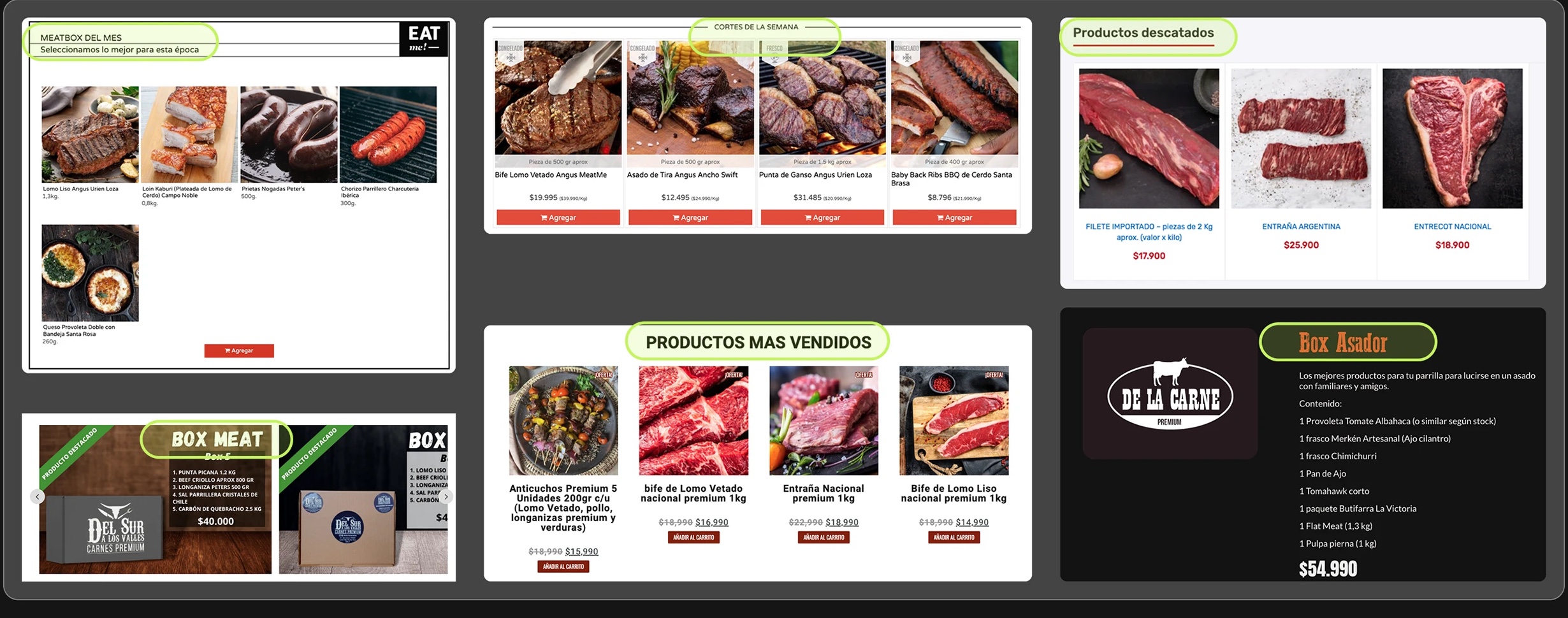
Add highlighted modules such as "recommended products", "box of the month" or "cuts of the week" to make quick decisions easier and raise the average order value.
2. Key information presented visually
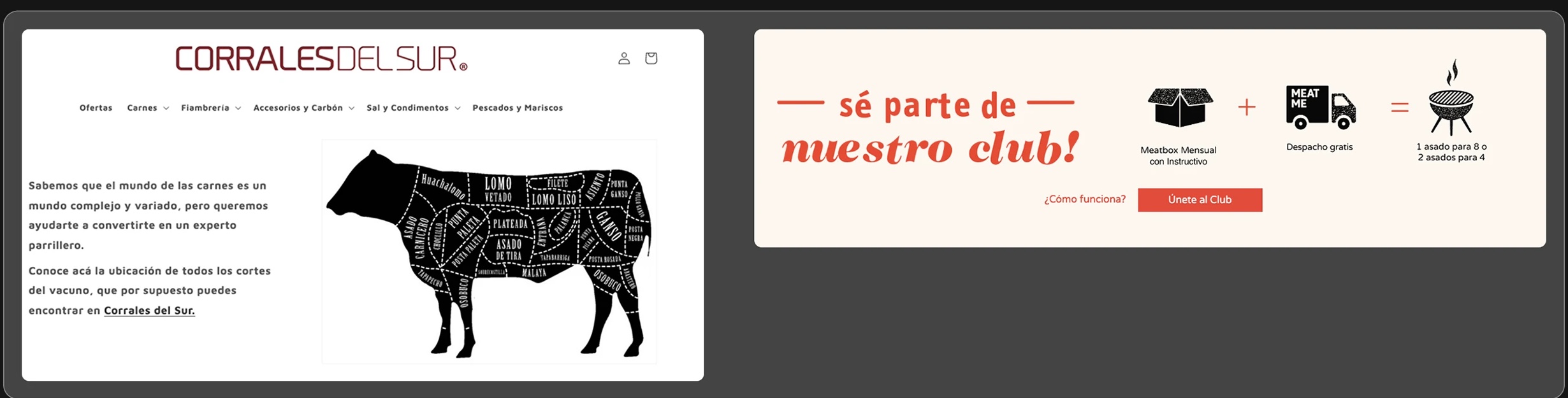
Integrate graphic resources such as the cow cut map, simplified instructions with icons and visualizations that help people understand the product better.
3. Menu with clear, hierarchical categories
Optimize the menu architecture by prioritizing categories according to purchase logic: brands, meat origin, type of animal, cuts and formats. A clear menu reduces friction and speeds up search.

4. Information on origin and sustainability
Highlight relevant information such as product origin, the animal's diet, production processes, certifications and even quantity per pack. This increases trust and improves conversion.
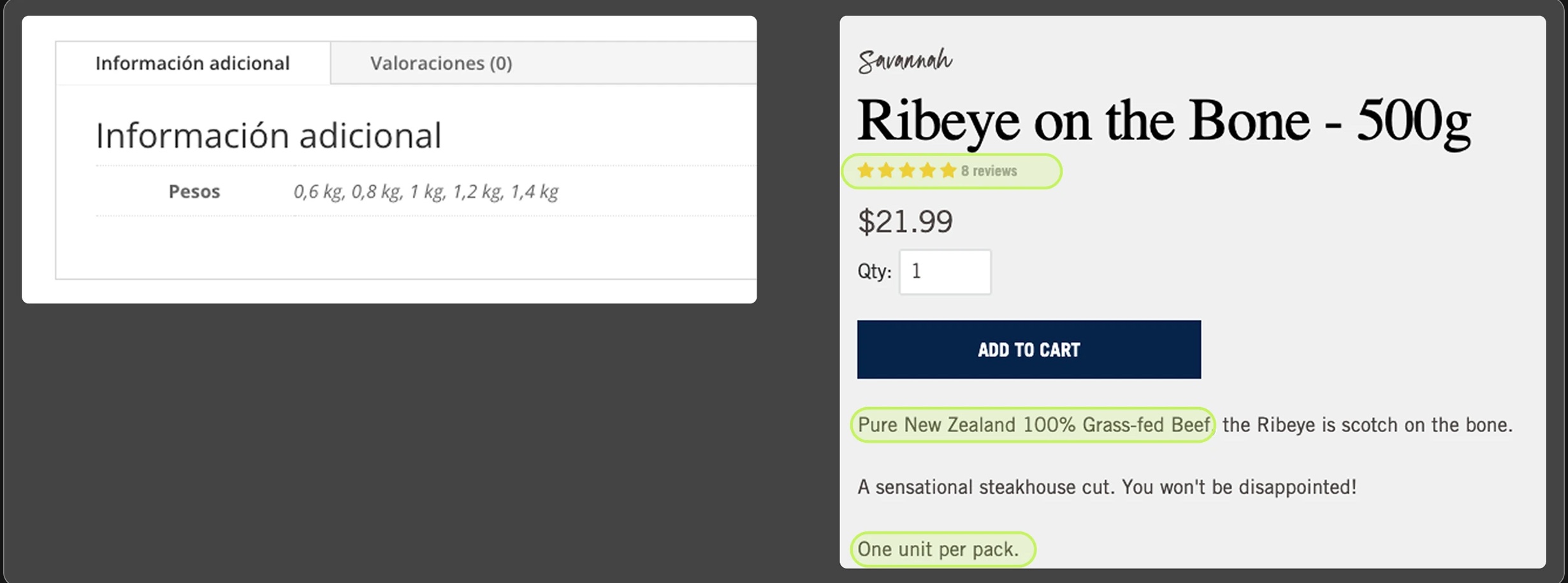
5. Add buyer reviews and ratings
Including real ratings, customer comments and per-product scores increases trust and reduces uncertainty at the moment of purchase. Reviews let users validate quality, learn from previous experiences and make faster, safer decisions, especially in sensitive categories like fresh food.

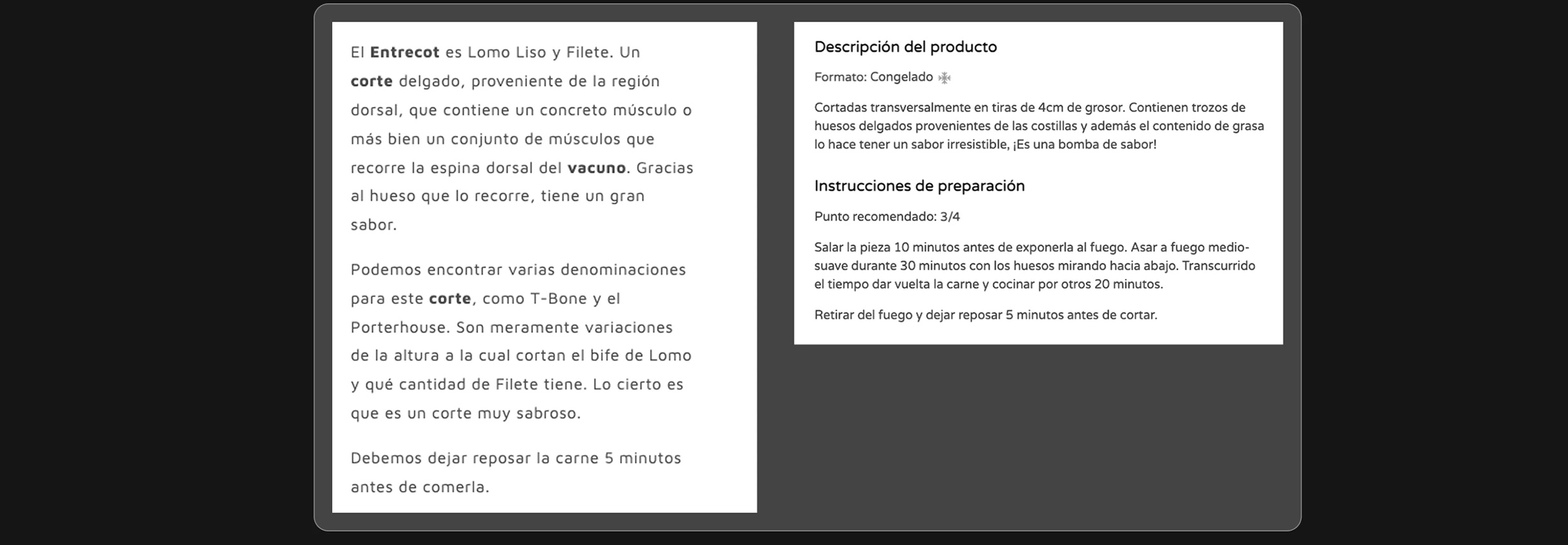
6. Complete, clear product details
Show precise, useful information about each cut: exact weight, cut type, texture, marbling level, suggested portions, recommended cooking methods and estimated preparation time. It helps users choose with confidence. For fresh products, clear details reduce friction, improve the perception of quality and lower returns or complaints.
UX/UI hypothesis
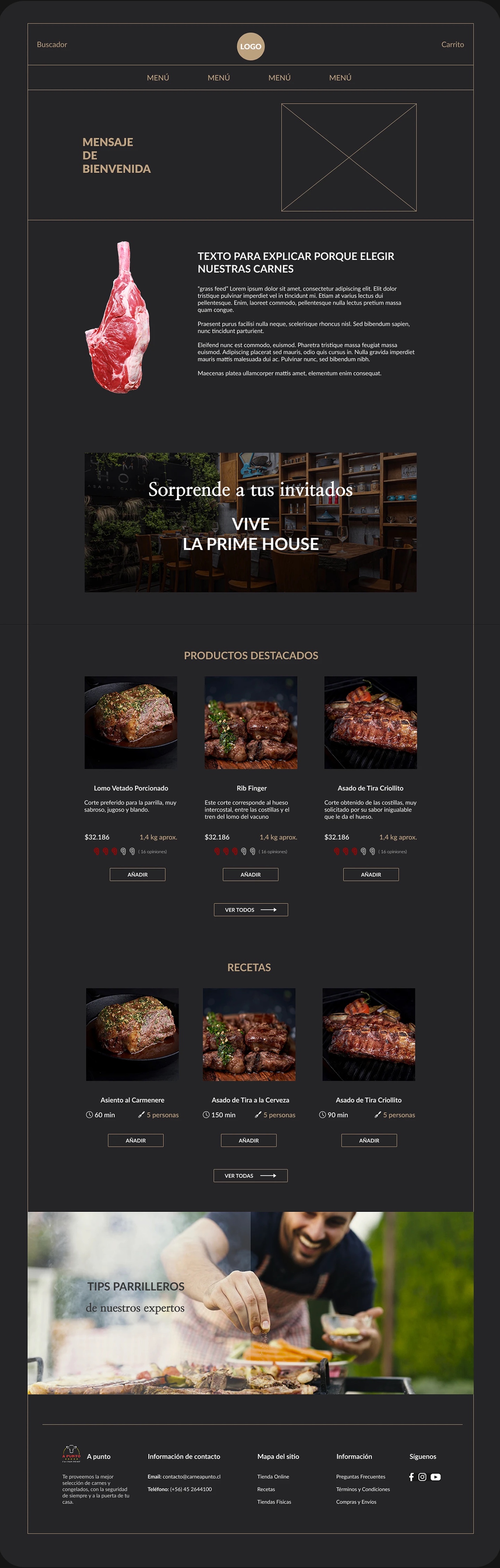
The following Home proposal is built from the benchmark findings, the competitor analysis and the needs detected in users. This hypothesis sets out an initial structure that prioritizes clarity, trust and speed in decision-making, incorporating elements common to the best-performing sites.
The design suggests
- A conversion-oriented hero with a clear message.
- Quick-purchase modules such as "Recommended cuts", "Featured products" or "Ready-to-grill boxes" to reduce friction and speed up decisions.
- Educational visual resources, such as a cut map and iconography that explains the purchase process simply.
- Inside, add information on origin, quality and sustainability, reinforcing the transparency users now demand.
- A hierarchical, easy-to-navigate menu that orders categories by purchase logic: cut type, origin, brands, type of animal or format.
- Customer reviews and ratings, integrated as social proof to reinforce trust in fresh products and reduce uncertainty before buying.
- Complete product details, including weight, marbling level, suggested portions, recommended cooking methods and cut-specific characteristics, to support an informed decision.
This hypothesis is not a final design but a strategic direction informed by evidence, meant to guide the next stages of ideation, wireframing and validation with users.
Conclusion
This review lets us understand the real opportunities for improvement and align the digital experience with the expectations of today's consumer.
With these findings and recommendations, the next step is to move toward validated design proposals that strengthen conversion, trust and brand value.